First time clients receive 20% off with Promo Code First20
The Cellular Cost of Stress on Fertility: How Mind-Body Medicine Restores Reproductive Harmony
This article discusses how holistic modalities like Reiki, hypnotherapy and guided meditation can become a powerful part of an integrative medicine approach to fertility. Learn how these self-care strategies can help you regulate your nervous system, take it out of chronic "fight-or-flight" mode and tell your body that it is safe to reproduce.
Fred P. Ernani, PhD
5/31/20264 min read


The Cellular Cost of Stress on Fertility: How Mind-Body Medicine Restores Reproductive Harmony
For couples navigating the journey toward building a family, the phrase "just relax and it will happen" can feel deeply dismissive. Yet, as an immunologist, I view this advice not as a vague platitude, but through the lens of cellular biology [1]. The connection between psychological stress and reproductive success is a hard scientific reality [1, 8].
When you are trapped in a cycle of high-stress deadlines, corporate demands, or the emotional rollercoaster of monthly negative pregnancy tests, your body perceives a threat [2]. In survival mode, your biology prioritizes immediate safety over reproduction [1, 2].
Understanding the precise cellular pathways of stress can empower you to use targeted mind-body modalities—such as clinical hypnotherapy, guided meditation, and Reiki—to shift your biology from a state of defense to a state of reception [3, 12].Reproductive health relies on an exquisite chemical conversation between your brain and your reproductive organs. This pathway is known as the Hypothalamic-Pituitary-Gonadal (HPG) axis [1].
The Neuroendocrine Blueprint: How Stress Halts Fertility
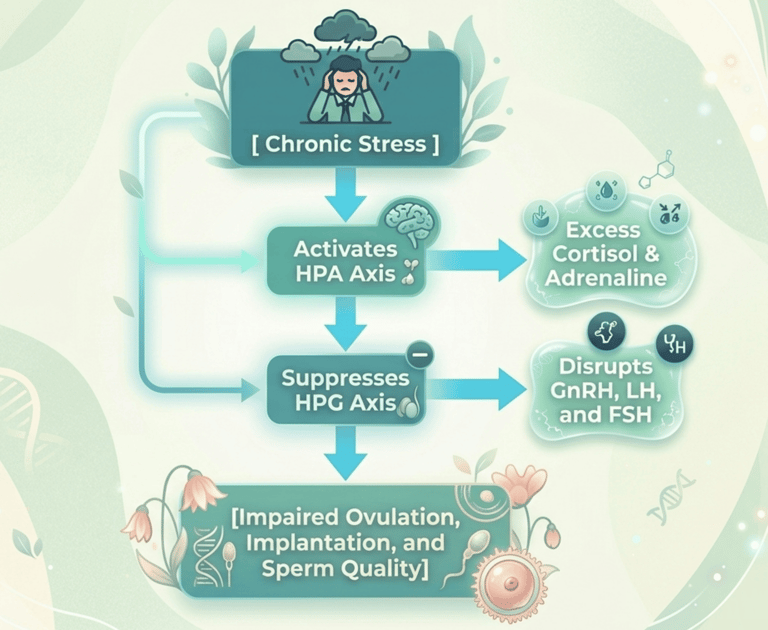
When chronic stress triggers your autonomic nervous system, it activates a competing pathway: the Hypothalamic-Pituitary-Adrenal (HPA) axis, which floods your system with cortisol and adrenaline [1, 8].
This biochemical shift impacts fertility in three major ways:
Hormonal Disruption: High cortisol levels disrupt normal neuroendocrine signaling, which can trigger anovulation, abnormal gamete transport, and luteal phase progesterone deficiencies [1, 8].
The Inflammatory Cascade: As an immunologist, I look closely at cellular inflammation. Chronic stress disrupts immune homeostasis, creating localized micro-environments that can impair healthy embryo implantation and compound conditions like pelvic inflammation [1].
Vasoconstriction: Elevated stress mediators activate the sympathetic pathway, causing severe vasoconstriction that reduces blood flow to peripheral systems—including the uterus and ovaries [1]. This state of chronic "fight-or-flight" can contribute to issues like tubal spasms [1].
Shifting the Biology: The Role of Hypnotherapy, Meditation, and Reiki
To optimize fertility, we must systematically signal to the nervous system that it is safe to reproduce. Blending scientific rigor with gentle healing arts allows us to quiet the sympathetic nervous system and engage the parasympathetic "rest and digest" pathways [3, 9].
1. Clinical Hypnotherapy: Rewiring the Stress Response
Hypnotherapy bypasses the analytical, anxious mind to access the subconscious, actively reducing infertility-related distress and cultivating psychological resilience [4, 7]. By using targeted therapeutic guided imagery, hypnosis helps individuals untangle the subconscious anxieties, medical trauma, or fears of failure that frequently accompany prolonged fertility journeys, providing a profound mind-body interaction that increases overall fertility readiness [5, 7].
2. Guided Meditation: Quelling Cellular Inflammation
Consistent guided meditation and mindfulness-based stress reduction (MBSR) act as a physiological brake on the HPA axis, turning off the nervous system's "false-fear alarm" [6, 9]. Clinical trials show that implementing mindfulness training significantly improves clinical pregnancy rates among couples undergoing reproductive treatments [3, 6]. By reducing anxiety and down-regulating distress, meditation restores systemic balance to support a highly receptive reproductive environment [3, 9].
3. Reiki: Restoring Energetic and Autonomic Balance
Reiki provides a non-invasive, deeply soothing experience that addresses the profound physical and somatic tension held in the body [10, 12]. Clinical data demonstrates that Reiki interventions significantly reduce systemic anxiety and lower circulating blood cortisol levels [10, 11]. When navigating the grueling scheduling demands of fertility protocols, Reiki allows individuals to shed chronic stress and restore a homeostatic equilibrium where cellular healing can thrive [12].
A Scientific Adjunct to Your Fertility Care
Nervous system regulation is not a replacement for specialized naturopathic or conventional fertility care; it is the ideal catalyst for it. When your body is no longer burning vital metabolic resources fighting perceived stress, it can fully utilize the clinical protocols, nutritional adjustments, and supplemental therapies prescribed by your integrative care team.
You do not have to carry the emotional and physical weight of this journey alone. Your body already possesses the blueprint for healing—sometimes, it just needs the quiet space to remember it.
Find Healing Within: Join Our Next Workshop
If you are ready to transition your body from stress to sanctuary, I invite you to experience these modalities firsthand.
Book a 15-Minute Exploratory Call: Let's discuss a personalized, 1:1 plan combining Hypnotherapy and Reiki tailored to your unique fertility journey. Visit our Hypnotherapy Page and Reiki Page to schedule, call or reach out through my contact form at the bottom of my web pages.
Reserve Your Spot: Join our upcoming live, interactive virtual workshop, "Finding Peace Within." Held live over Zoom, this workshop provides a powerful, restorative group environment to reset your nervous system and cultivate deep, biological calm.
References
Rooney, K. L., & Domar, A. D. (2018). The relationship between stress and infertility. Dialogues in Clinical Neuroscience, 20(1), 41–47. PubMed Central
Mass General Brigham. (2025). Does Stress Affect Fertility Treatments? Mass General Brigham Article
Frederiksen, Y., et al. (2015). The effect of mind-body interventions on psychological and pregnancy outcomes in infertile women/couples: a systematic review and meta-analysis. Human Reproduction, 30(11), 2564–2573. PubMed
Galhardo, A., et al. (2020). An internet-based mind/body intervention to mitigate distress and promote conception in infertile women. Journal of Psychosomatic Obstetrics & Gynecology, 41(3), 204–213. PubMed
Latifnejad Roudsari, R., et al. (2025). Effect of guided imagery relaxation on stress and quality of life in infertile women. Journal of Evidence-Based Care. PubMed Central
Ghobadi, M., et al. (2025). The effects of lifestyle improvements and mindfulness-based stress reduction on in vitro fertilization outcomes in infertile couples: A randomized controlled clinical trial. Journal of Psychosomatic Research. PubMed
Oskovi-Kapranzad, M., et al. (2022). The effect of hypnofertility on fertility preparedness, stress, and coping strategies. International Journal of Clinical and Experimental Hypnosis, 70(4), 382–395. PubMed
Louis, G. M., et al. (2011). Stress reduces conception probabilities across the fertile window. Fertility and Sterility, 95(7), 2184–2189. PubMed
Pal, A., et al. (2020). Application of Mindfulness-Based Psychological Interventions in Infertility. Journal of Human Reproductive Sciences, 13(1), 3–11. PubMed Central
Er, S., & Demirkiran, G. (2024). Is Reiki effective in reducing heart rhythm, cortisol levels, and anxiety? Alternative Therapies in Health and Medicine. PubMed
Díaz-Rodríguez, L., et al. (2011). Immediate effects of reiki on heart rate variability, cortisol level, and body temperature in health care professionals with burnout syndrome. Biological Research for Nursing, 13(4), 376–382. PubMed
McManus, D. E. (2017). Reiki Is Better Than Placebo and Has Broad Potential as a Complementary Health Therapy. Journal of Evidence-Based Complementary & Alternative Medicine, 22(4), 1051–1057. PubMed Central
This article is for educational and informational purposes only and is not intended as medical advice, diagnosis, or treatment. Reiki, hypnosis, and guided meditation are complementary approaches and should not replace care from a licensed healthcare professional. If you have ongoing symptoms, a medical condition, or concerns about your physical or mental health, please consult a qualified healthcare provider
Contact
Reach out for a free 15 minute call to discuss your needs and see if I am a good fit for you.
Phone
info@TheTranquilPresence.com
+1-650-518-7311
© 2026 Fred P. Ernani, PhD . All rights reserved.